
If this is your first time visiting Ibiza, don’t start with the clubs. Start with the salt. Ibizan salt funded the walls you’ll walk through to reach the old city. It drew the Phoenicians to the island’s southern flats around 2,700 years ago and kept trading families fed for centuries after.
Today it still leaves the island on cargo ships out of Sa Canal port, bound for northern Europe. Traces of the old salt-transport railway can still be found near the shore.
That same salt is why Ibiza’s signature stew exists, why flamingos arrive from late summer through autumn, and why one of the great food souvenirs in Spain is now stocked in airport boutiques worldwide.
Pull that thread and you get a version of Ibiza you won’t soon forget.
Getting Here and Getting Around
Flights from EU and the UK are plentiful from May through October, with direct services from most major airports. Shoulder-season fares in May and September are noticeably gentler than peak July and August, and the island is frankly better in those months anyway.
A car isn’t essential for every trip to Ibiza, especially if you’re sticking to the main towns, popular beaches, and nightlife areas. The island’s bus network is reliable, affordable, and comfortable, with good connections between many of the key spots.
That said, if you want the freedom to reach quieter coves, smaller villages, or more remote corners of the island, hiring a car or scooter makes a big difference. Pick one up on arrival if exploring beyond the usual routes is part of the plan, and download offline maps before you leave the airport, as signage can be patchy in places.
Most suggested bases below sit 20 to 35 minutes from Ibiza Town. The north takes a little longer from Sant Antoni, but the roads are good and the views justify a slower pace.
Where to Base Yourself
Sant Antoni de Portmany is the practical first-timer choice. It’s central, it’s well connected to the west-coast beaches, and it’s genuinely better for eating than its reputation suggests. Ignore the West End strip; the town itself has a good market, a bakery scene worth getting up for, and a handful of excellent tapas bars where the clientele is mostly locals.
Ibiza Town, Eivissa [ay-VEE-suh] is the right base if you’re spending serious time at the old city. The port, Dalt Vila, the marina, and the best restaurant concentration on the island are all on your doorstep. Pricier, but a few nights here are worth it.
The north (around Sant Joan, Santa Gertrudis and Portinatx) is quieter, more village-paced, and ideal if the undiscovered-Ibiza feeling is what you’re after. Just factor in that the drives to the west-coast beaches are longer from up there.
The Food Thread (And Why It Runs Through Everything)
Ibiza has a proper food culture. Not a scene. A culture, built from what fishermen threw into clay pots, what farmers slaughtered in autumn, what herbs grow wild in the interior, and what the salt trade made possible.
When you see bullit de peix [boo-YEET də PESH] on a menu, order it: it’s a poached fish first, then a saffron rice cooked in the same broth, two courses out of one pot. When you see flaó [flah-OH] for dessert, that’s Ibiza’s answer to cheesecake, all fresh goat’s cheese and a whisper of mint. And always say yes to the digestif.
In Sant Antoni, pull up at Bar Es Clot (opposite the church). It sits comfortably away from the tourist strip with tables on the street, char-blistered octopus, gambas al ajillo still spitting in their garlic oil, and a sangria or tinto de verano jug. For breakfast, ÚNICA Bakery & Breakfast is the one. Warm house-made sourdough, croissants with proper shatter, and staff who clearly want you to stay.
In Ibiza Town, the lunch institution is Bar La Bodeguilla (near the bus station). It’s a family-run bar away from every tourist route, the pulpo is outstanding, smoky and tender off the plancha, and the decor involves farm machinery. No bookings, so go early or expect a wait.
In the north, the anchor is Bar Costa in Santa Gertrudis. Dark, art-covered, famous for its hand-sliced jamón ibérico, and the kind of atmosphere that makes an hour pass without you noticing. More on the north below.
Sant Antoni and the West Coast
Sant Antoni’s reputation got built by the West End and the sunset strip. Neither of those is the reason to go. The reason is that the town sits almost exactly in the middle of the best stretch of west-facing coast on the island.
The beaches in either direction earn the postcard reputation. Cala Comte (Cala [KAH-lah] means cove; also called Platges de Comte) is the benchmark: a series of small coves with the islands of S’Illa des Bosc and Illa des Conills sitting just offshore, turning the water a colour that seems implausible. Gets extremely busy from 11am in summer, so get there early or accept the company. Cala Bassa, a few kilometres south, is larger and faces south-west, which makes it one of the better spots on the island for afternoon light. Cala Salada and Cala Saladeta are a pair of coves north of town connected by a cliff path of about ten minutes; the smaller Saladeta is the one to go to, quieter and lovely.
And Sa Punta Galera is not a beach. It’s a flat, sculpted rock platform where people swim off shelves and watch the sun go down. Worth an afternoon of doing absolutely nothing on.
Ibiza Town, Dalt Vila and Two Sides of the Walls
The city on the hill
Dalt Vila [DALT VEE-luh], the old upper town sits up on the hill above the port.
The walls you walk through are massive, honey-coloured and improbably intact. They were designed in the 1550s by an Italian military architect called Giovanni Battista Calvi, and built so precisely they were never breached. UNESCO gave them World Heritage status in 1999, alongside similar Renaissance-era defences in Montenegro and Croatia. The inscription notes they had “a profound influence on the development of fortifications in the Spanish settlements of the New World.”
Then climb. The cathedral at the top is plain by Spanish standards, which is part of its appeal. The views from the upper ramparts, back over the port and south towards Formentera on a clear day, justify every step.
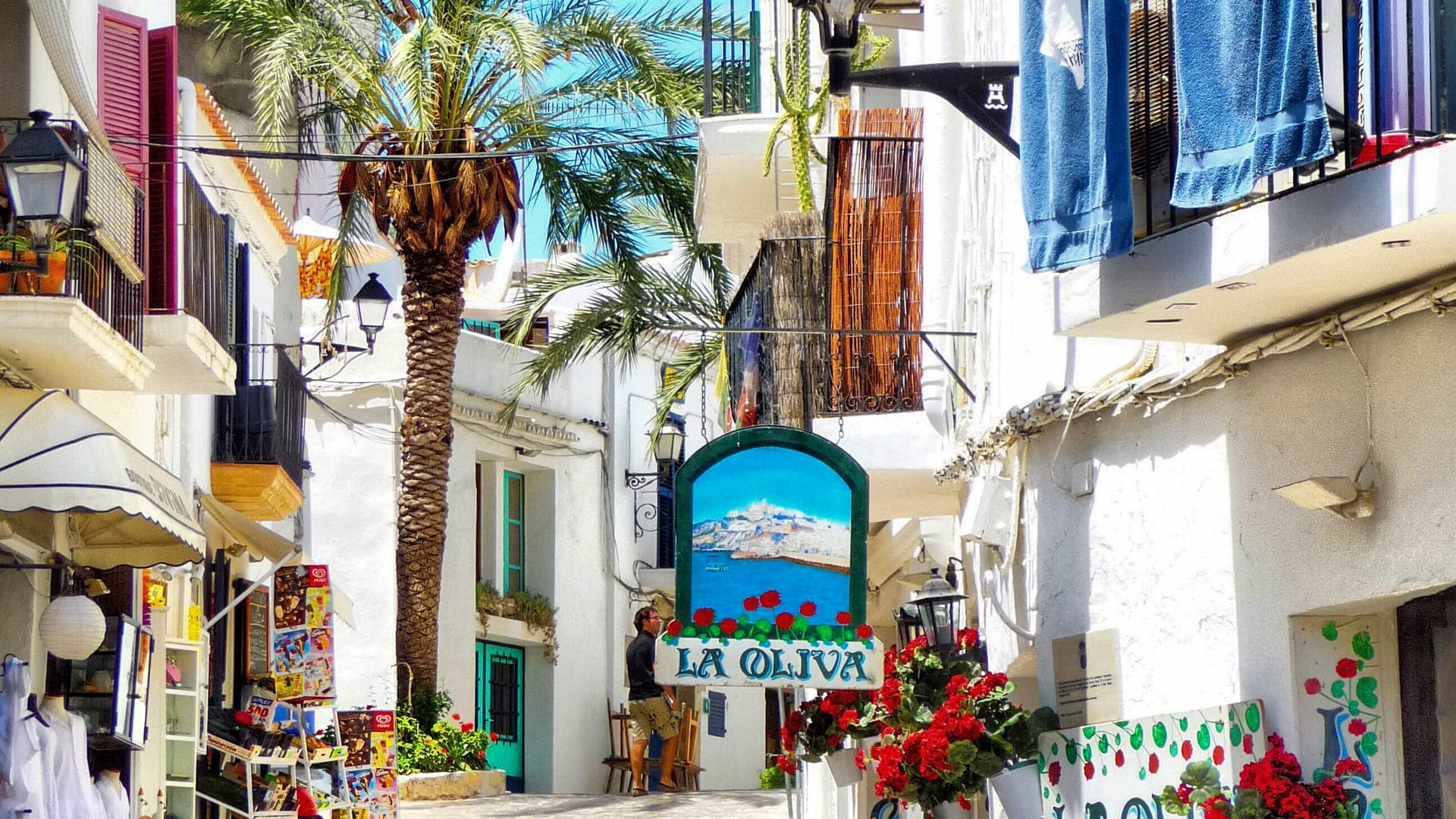
Walk in through the Porta de ses Taules, the main gate, topped by Philip II’s coat of arms and flanked by Roman statues. You have to see it once. On your return, skip the crowds and slip through Portal Nou instead, a hidden stone tunnel most visitors never use. This hidden stone tunnel slips you into a quieter side of Dalt Vila, closer to S’Escalinata, where the old town feels suddenly private: whitewashed walls, a sleeping cat in the shade, laundry hanging from a balcony.
From there, climb slowly. The cobblestones have been polished smooth by 500 years of feet and can feel like ice even when they’re bone dry, so leave the flat plastic-soled sandals at home. The cathedral at the top is plain by Spanish standards, which is part of its appeal, and the views from the upper ramparts, back over the port and south towards Formentera on a clear day, justify every careful step.
Below the walls, in the Penya quarter, spend time on Calle de la Virgen: a narrow lane of whitewashed houses, studios and old bars, where the foot-pace feels genuinely different from the rest of the island. This is where the town breathes.
Puig des Molins: the city the dead built first
Before Dalt Vila, before the salt flats even, the Phoenicians were burying their dead on the hill next to the one that would later become the old city. Puig des Molins [pootch des moh-LEENS], “hill of the windmills” is one of the largest Phoenician and Punic necropoli in the western Mediterranean: over 3,000 tombs cut into the rock, spanning centuries of use from around the 7th century BC through the Roman period. It’s part of the same UNESCO designation as Dalt Vila, Sa Caleta and the Posidonia seagrass meadows, but it rarely gets the same attention.
The museum at the entrance has a thoughtful collection of funerary objects (terracotta figurines, jewellery, oil lamps) that make the scale of the site legible.
Finding it is easy: it sits about 500 metres from the Porta de ses Taules, down the hill towards the modern city. Do Dalt Vila in the morning, Puig des Molins in the early afternoon, and Bar La Bodeguilla for lunch in between. That’s a good day.
The port zone and where to eat
The port area below Dalt Vila is where Ibiza Town’s dining concentrates.
La Barra de la Bientirada does modern Spanish tapas with a rotating tortilla special (the kitchen cycles through sobrasada, truffle, goat’s cheese) and a buzzy, tiled interior that fills up fast. Book ahead or arrive by 7pm.
Home Loos is a family restaurant (interestingly established by a Former Dutch Rugby player) with 35-odd tapas on the menu and a paella, golden and properly crusted at the bottom, that earns the return visit people keep writing about. Cash only, so bring some.
For something fast and cheap after a long walk around the old city, TKO Tacos Eivissa does exactly what it says: very good tacos, frozen margaritas or Agua de Jamaica, counter service, no fuss.
Northern Ibiza: A Different Island Starts Here
The north of Ibiza has a slower, quieter rhythm than the island’s busier corners, and it rewards the effort of getting there. If you have a day to spare, it’s worth the drive for the pine-covered hills, small villages, hidden coves, and the feeling that Ibiza can still keep a few secrets.
Santa Gertrudis de Fruitera is about twelve kilometres from Ibiza Town, up a road lined with red earth and fig trees. A village square, an 18th-century church, and Bar Costa anchoring the whole thing. It’s the kind of place where you intend to have one coffee and end up staying for two hours. The square is small enough to feel unhurried and interesting enough to make you want to come back.
Benirràs beach, further north, is a pine-backed horseshoe cove with clear water. On Sunday evenings, a tradition of sunset drumming has played out on the rocks at the water’s edge since 1991, attracting thousands of people at the end. It began as an anti-war gathering and grew into one of the most distinctive things on the island. The large, organised drumming has faced restrictions in recent years, however, smaller informal drumming sessions take place now every day at sunset. The beach itself is worth going to whatever the day. In summer there is also a small hippy market every day from Friday till Tuesday.
The coast above Portinatx has its own rewards.
Cala d’en Serra is a pristine cove. Above it, clinging to the cliff face, sits the concrete skeleton of a holiday complex designed by the renowned Catalan architect Josep Lluís Sert. Construction began in the mid-1970s. Sert died in 1983 and the project was never completed. It’s stood empty for over forty years, and the local council has now voided the permits and lined up the demolition. So it might not be standing much longer.
If you walk up to it, treat the structure as the ruin it is. There is rubble, loose stones and holes in the ground throughout, and the stability of the whole thing is genuinely questionable. Enter at your own risk.
Further along the coast, Cala Xarraca catches the wind badly in certain conditions (firsthand knowledge), but on a calm day is gorgeous. Playa de Portinatx is a settled bay with a good stretch of sand and an easy pace.
Southern Ibiza: Salt, Phoenicians and a 2,700-Year-Old Trade
The south is where the salt story completes itself. It’s also where the beaches at the very tip of the island are among the finest.
Sa Caleta, about ten kilometres southwest of Ibiza Town, is a rocky headland between two beaches. Walk out to the end of it and you’re standing on the remains of an excavated Phoenician settlement: stone foundations from around the 7th century BC, part of the same UNESCO designation as Dalt Vila and Puig des Molins. There isn’t many visitors, which is entirely to your advantage.
From Sa Caleta, head further south into Ses Salines Natural Park, where the working salt flats that powered this island’s economy for two millennia are still producing today. The product, Sal de Ibiza, is exported internationally and is another one of the genuinely good food souvenirs you can bring back from the island.
Between August and October, flamingos arrive at the salt flats in sometimes significant numbers and stay through winter. The walk south towards Torre de Ses Portes takes around 45 minutes each way, with flamingos feeding in the brine pans on one side and the open sea on the other. It’s one of those experiences that doesn’t have a price tag.
The two beaches at the southern tip, Ses Salines (long, sandy, beach-bar scene) and Es Cavallet (quieter, naturist section, spectacular on a calm day), are both excellent in their different registers.
Mirador des Vedrà used to have two main viewing spots: the official lookout on the road, and a slightly longer walk from a pull-off further south that put you above the cliff edge. This once the default sunset stop has become increasingly restricted, with unofficial parking areas and paths blocked after years of overcrowding and pressure on private land. Rather than trying to force the old route, see the rock from Cala d’Hort, from one of the marked public trails, or, best of all, from the water on a boat trip.
The Es Vedrà [es veh-DRAH] itself is a craggy limestone rock rising sharply from the sea, uninhabited, dramatic, and wrapped in more stories than any limestone stack reasonably needs. Some say it was home to the Sirens who tried to lure Odysseus off course; others link it to Atlantis, Tanit, UFO sightings, or strange magnetic energy that supposedly sends compasses spinning. You do not need to believe any of it to enjoy it. Go late afternoon, stay where access is permitted, avoid parking on road shoulders or verges, and let the golden hour light do the convincing.
Hippie Markets
Four markets, four very different characters. Pick at least one.
Las Dalias (Sant Carles, Saturdays throughout the season) is the one that earns the reputation: running since 1985, with genuinely varied stalls, a food section better than most markets manage, and a summer night market worth a completely separate visit. Check lasdalias.es for current night market days, as these shift through the season. Start with the Saturday.
Punta Arabí (Es Canar, Wednesdays in season) is larger and more commercial, but the scale gives it a different energy that works well in a busy week. If you’re going, combine it with lunch at Casa Juan right by the market: a family-run cafeteria where the paella comes out fresh and steaming, and the prices belong to a kinder decade.
Sant Jordi (the racetrack, Saturdays) is local in a way the others aren’t: more flea market than hippie market, agricultural produce, second-hand oddities, almost no tourist infrastructure. Worth an hour if you’re based in the south.
Cala Benirrás (Benirrás beach, San Miguel, Friday to Tuesday in season) is a lovely add-on to an afternoon on one of Ibiza’s most atmospheric beaches. In summer, stalls usually appear from late morning into the evening, with a relaxed mix of boho fashion, handmade jewellery, accessories, crafts, and pieces gathered from around the world. Come for a browse, stay for the live music, and let it roll naturally into sunset drums.
When to Go
May and September are the answer. The sea is warm enough, the beaches are manageable, the restaurants have availability, and the island has a pace closer to its natural one.
June through August is full season in every sense: higher prices, higher temperatures, higher everything.
October is genuinely underrated: flamingos in the salt flats, sofrit pagès [soo-FREET pah-ZHESS] on menus, which makes most sense in cooler months anyway, lower prices across the board, and that particular quality of autumn light on the west-facing cliffs.
If you’re coming for the clubs (as plenty of people do), the main season runs from the first opening parties in May through the closing parties in October. Opening and closing parties are often better value than peak summer: the same DJs, smaller crowds, prices that don’t require a spreadsheet to plan around.
Practical Ibiza
Book restaurants ahead. This applies especially to anywhere in Ibiza Town and the popular west-coast spots. For tapas bars and local places, walking in works fine. But at peak times, give yourself options.
Bring cash. Several places on the island don’t take cards. Some amount of cash (or working knowledge of your nearest ATM) is a practical skill.
Taxis are metered and generally reliable. The Sant Antoni to Ibiza Town run takes around 25 to 30 minutes, and the fare reflects that with around 30 €. Book in advance for late nights in summer; demand significantly outstrips supply after midnight in July and August.
Sea Bus. As an fun and easy alternative to taxis, take the sea bus between Ibiza Town, Figueretas, and Playa d’en Bossa. The crossing takes around 20 minutes, costs only a few euros each way, and avoids the traffic that can make taxis both slow and expensive. It is also the prettier route: you get the breeze, the coastal views, and, arriving into Ibiza Town, a memorable first look at Dalt Vila from the water.
North coast roads at night have no lighting and some properly sharp corners. Factor that into your evening plans.
Prices are high, especially in summer. The mitigation is the same everywhere in Spain: know where locals eat, use breakfast and lunch at good neighbourhood spots to offset the evening spend, and save the beach club budgets for the two or three places that genuinely earn it.
What to Bring Home
Three things worth putting in your bag before you leave.
Sal de Ibiza: the gourmet sea salt from the Ses Salines flats. The fleur de sel is the one to start with. The dark chocolate bar with salt flakes makes a reliable gift. Sold at good supermarkets across the island and at airport shops.
Hierbas ibicencas [YAIR-bas ee-bee-THEN-kas]: the island’s herbal digestif. The seca (dry) version is the one to go for if you want the more botanically intense style. ARTESA and Marí Mayans are two well-regarded local producers worth looking out for. Serve it cold, over ice.
Local olive oil: Ibiza produces a small amount from centenarian trees in the interior. It’s not always easy to find but worth asking about at the Saturday markets.
Ibiza has more layers than the club brochures ever let on: the food, the salt story, the village pace of the north, the beaches that earn the drive. So which thread are you most excited to follow?
Visited in spring 2024, revised in summer 2025 and spring 2026. Practical details can change, it’s always worth checking opening times and current status before your trip.