
Cretan food is one of the great surprises of European travel. It isn’t quite the same as mainland Greek cuisine, though the foundation is shared. Centuries of Minoan, Byzantine, Venetian and Ottoman influence have produced something earthier, more generous and more distinctly its own.
Olive oil is poured with a free hand, vegetables roasted low and slow, lamb pulled from the hills, seafood landed the same morning. Crete is widely credited as the birthplace of the Mediterranean diet, and one meal here makes it easy to see why
Whether you’re planning a full island road trip or settling into one corner of Crete for a week, this guide covers the essential dishes to seek out, the five restaurants where we ate them best, plus the markets and produce worth a place in your suitcase. We’ll travel from Heraklion in the east to Chania in the west, with stops in Rethymno and Agios Nikolaos along the way.
Don’t read this on an empty stomach. You’ve been warned!
Part of our Crete series. Also check out Top 10 Beaches in Crete and Top 10 Things to Do in Heraklion.
How a Cretan Meal Works
Before we get into the dishes, a quick note on how eating in Crete actually works. Understanding it makes the whole experience better.
A proper Cretan meal is built around mezedes [meh-ZEH-des], small shared dishes similar in spirit to Spanish tapas. They arrive at the table first. You might order three or four between two people. Dakos. Crispy feta. Tzatziki. Maybe a saganaki. Then mains. Then complimentary sweets and raki. The whole thing takes two to three hours, and that’s the point.
Dinner kicks off late by northern European standards. Most tavernas fill up from around 9pm onwards. Arriving at 7pm isn’t wrong, but you’ll be eating in a quieter restaurant. If atmosphere matters to you, plan accordingly.
One more thing. Don’t try to rush a Cretan meal. The pacing is deliberate and generous. It’s one of the best things about eating here.
A Quick Note on Cretan Cheese
You’ll notice quickly that the cheese in Crete isn’t always feta. Here’s a short translation guide before we get to the dishes.
Myzithra [mi-ZEE-thra] is a fresh, mild whey cheese made from sheep and goat milk. It’s lighter and creamier than feta, with a gentle sweetness. You’ll find it in dakos, on the Cretan salad, inside kalitsounia, and in the Chania version of bougatsa.
Graviera Kritis [gra-VEE-er-a] is a hard, aged sheep’s milk cheese with a slightly sweet, nutty flavour. It carries PDO protection, meaning it can only be called Graviera Kritis if it’s made on Crete. Excellent fried as saganaki and outstanding with local honey.
Anthotiros [an-THO-tee-ros] is semi-soft and mild when fresh, harder and saltier as it ages. Often crumbled over pasta or salads.
Pichtogalo Chanion [pich-to-GA-lo CHA-nee-on] is a soft, creamy spreadable cheese specific to Chania. Sharp and tangy, eaten with bread or used in local pies. Another PDO product you genuinely can’t find outside Crete.
Cretan Dishes You Can’t Leave Without Trying
These are the dishes you’ll see across the island, on every taverna menu, and that should anchor your eating itinerary.
Dakos
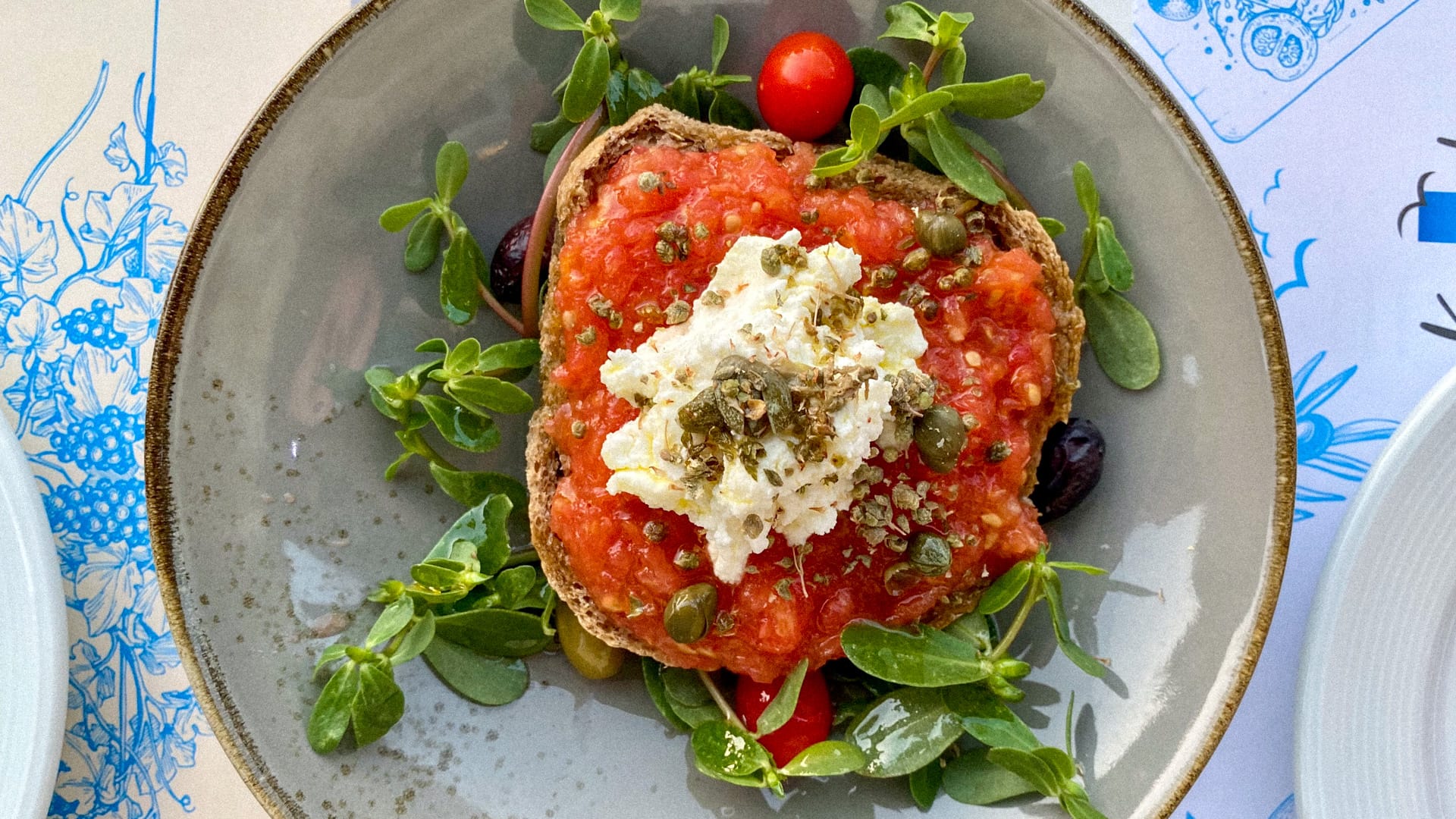
Think of dakos as Crete’s answer to Italian bruschetta, and arguably the better one. A thick, twice-baked barley rusk called paximadi is briefly softened in good olive oil, then piled with crushed fresh tomatoes, crumbled myzithra cheese, dried oregano and another drizzle of oil. Simple, deeply flavoured, and present on almost every menu as a starter. We loved it so much we’ve been making it at home ever since.
What to look for: the rusk should have a little resistance in the centre, soft where the tomato has soaked in but not soggy throughout. A good dakos is about texture as much as flavour.
Cretan Salad (Horiatiki Kritiki)
You know the Greek salad. Tomatoes, cucumber, olives, red onion, peppers and a slab of feta with olive oil. The Cretan version adds boiled potatoes and a hard-boiled egg, swaps the feta for fresh, mild myzithra cheese, and serves the whole thing over a barley rusk. It’s heartier, a little more complex and, if we’re being honest, even better than the standard.
Crispy Feta
A beloved starter you’ll find across the island. A block of feta is wrapped in filo pastry and fried or baked until deeply golden, arriving at the table drizzled with local honey. The combination of salty, crispy and sweet takes a moment to get your head around and then becomes immediately, obviously correct. Order one for the table.
Shrimp Saganaki
Saganaki refers to the small two-handled pan the dish is cooked in, so you’ll see the name applied to several dishes across Greek menus. The shrimp version is prawns simmered in a rich tomato sauce with crumbled feta melting through. Best eaten with plenty of fresh bread to deal with the sauce. One of the most satisfying things you can order in Crete.
Souvlaki
Pork is the traditional choice for souvlaki, small cubes of marinated meat grilled on a skewer, though chicken is equally popular. It arrives with fries, a wedge of lemon and tzatziki. Squeeze that lemon directly onto the meat. Trust us on this one.
Moussaka
If you’ve had moussaka before, Crete may still surprise you. Layers of spiced minced meat and soft, smoky aubergine are topped with a thick, baked béchamel, often arriving at the table in its own clay pot. That aubergine smokiness is what sets the best versions apart. It adds a depth that’s hard to place at first and impossible to forget.
Lamb Chops
Bone-in, grilled over high heat, served with lemon and fries. Simple and exceptional. Crete produces outstanding lamb. Keep reading to find out where we had the best on the island.
Gyros [YEE-ros]
Pork or chicken carved from a rotating spit, served in a warm pita with fries, tomato, onion and a generous helping of tzatziki. You’ll find gyros everywhere from quick-lunch spots to sit-down restaurants. It’s a deeply satisfying meal at any time of day and never disappoints.
Tzatziki
Strained Greek yoghurt mixed with grated cucumber, garlic, fresh dill or mint and a generous pour of olive oil. Cretan tavernas will often bring it to the table on the house alongside fresh bread before you’ve even ordered. Never refuse it.
Greek Yoghurt
Thick, creamy and nothing like what you’ll find in most supermarkets back home. It’s a breakfast staple across the island, served with local honey or seasonal fruit in hotels, cafés and bakeries. Start every morning here.
Greek Freddo Espresso
Coffee culture in Greece is a serious matter. The freddo espresso is a double shot vigorously shaken with ice, often in a cocktail shaker or electric frother, until it produces a thick, cold foam. It’s then poured over more ice. You choose your sugar level when you order: plain, medium or sweet. In summer heat, it’s non-negotiable.
Raki (Tsikoudia)
Raki is what the rest of Greece calls it. In Crete, you’ll hear tsikoudia. It’s a clear, potent spirit distilled from the grape skins, seeds and stems left after wine production, similar in character to Italian grappa. Almost every restaurant will bring a small glass to the table on the house at the end of your meal, often with a sweet or piece of fresh fruit. It’s a gesture of hospitality as much as anything else. The fruit-flavoured varieties in local shops are well worth seeking out. The melon one in particular. Yamas, cheers!
Looking for things to do in Crete?
Only in Crete: Dishes You Won’t Find Anywhere Else
The dishes above appear across Greece. The ones below are different. They’re either unique to Crete or so deeply tied to the island that they warrant a separate mention. If you want to eat like a Cretan rather than a tourist, this is where to focus your attention.
Apaki [AH-pa-kee]
A Cretan smoked pork unlike anything you’ll find on the mainland. Lean pork is marinated in vinegar and herb oil, then slowly smoked over sage, thyme and other aromatic herbs. The result is intensely flavoured, slightly tangy, smoky and rich. It’s served in thin slices as part of a meze platter or tucked into salads and omelets. The technique reflects centuries of food preservation on the island, and it tastes far better than its description on a menu suggests. Order it if you see it.
Lamb with Stamnagathi [stam-na-GA-thi]
This is the one dish you genuinely cannot eat anywhere else. Stamnagathi is a wild bitter green similar to chicory, and it grows only in the mountains of Crete. It’s slow-cooked with local lamb in olive oil, lemon and herbs until both the meat and the greens are deeply tender. The bitterness of the greens cuts through the richness of the lamb in a way that’s been feeding Cretans for centuries. It appears on menus mainly in spring and early summer when the greens are at their best. If you’re here then, order it.
Gamopilafo [ga-mo-PEE-la-fo]
Translated literally: wedding rice. This is rice slow-cooked in a rich broth made from boiled lamb or goat, finished with lemon and staka, a deeply flavoured clarified butter made from goat’s milk. Traditionally served at Cretan weddings, it now appears on restaurant menus across the island. It’s simple, hearty and unlike any rice dish you’ll have had before. The staka is the thing to notice. It adds a depth that regular butter simply doesn’t have.
Boureki [boo-REH-kee]
A baked casserole from western Crete. Thin slices of courgette and potato are layered with myzithra or feta, fresh mint and a little flour to bind everything. It arrives at the table warm, cheesy and satisfying. The mint cuts through the richness more than you’d expect. An excellent choice if someone at the table wants to eat vegetarian without sacrificing any flavour.
Tomatokeftedes & Kolokithokeftedes [to-ma-to-kef-TE-des / ko-lo-ki-tho-kef-TE-des]
Tomato fritters and courgette fritters. These crispy, herb-laced starters are beloved across the island, and easy to overlook if you’ve gone straight for the dakos and tzatziki. The tomato version mixes ripe summer tomatoes with feta, basil and oregano, then deep-fries the lot until golden. The courgette version uses grated courgette with mint and feta. Order at least one as a starter.
Horta [HOR-ta]
Wild foraged greens, boiled or steamed, dressed with good olive oil and lemon. This sounds like a side dish you might safely ignore, but it isn’t. The range of greens changes with the season, and the quality of the olive oil means a plate of horta at a good taverna can be one of the best things you eat. It also explains why Cretans live so long.
Chochlioi Boubouristi [choch-lee-OI boo-boo-REE-stee]
Snails. Specifically, pan-fried in olive oil with rosemary, then deglazed with vinegar. They have Minoan-era roots on this island, and Crete has more than 40 ways of preparing them. This preparation is the most beloved. They’re crunchy on the outside, tender in the middle, and they taste of the hillside herbs the snails have been eating. They’re not on every menu, but when you see them, order them. You’re eating something with a history stretching back further than most European countries exist.
Cretan Sweets: Save Room
If you’ve never arrived at a restaurant already full of starters and found yourself ordering dessert anyway, Crete will change that. These are the sweets worth making space for.
Bougatsa [boo-GA-tsa]
Start your morning here. Thin phyllo pastry is stretched until nearly translucent, wrapped around a filling, then baked. In Crete, particularly in Chania, the filling is myzithra cheese rather than the sweet semolina custard you’ll find in Thessaloniki. It arrives at the table piping hot, cut into small squares and buried under powdered sugar and cinnamon. The slight saltiness of the cheese against the sweetness of the topping is one of those combinations that makes immediate, obvious sense.
Find a seat at Bougatsa Iordanis in Chania, open since 1924 and often cited as the oldest bougatsa shop on the island. Arrive early. Expect a queue. It won’t disappoint you.
Loukoumades [loo-koo-MA-des]
The Greek answer to a doughnut, though lighter and less sweet than that comparison suggests. Small balls of yeasted dough are fried until golden, then drizzled with thyme honey and dusted with cinnamon and crushed walnuts. They’re best eaten warm from a dedicated loukoumades stand, which typically comes alive in the evening. One of the most reliably good things you can eat in Crete for a few euros.
Kalitsounia [ka-li-TSOO-nee-a]
Small, hand-formed pastries with a cheese and honey filling. The sweet version uses myzithra, cinnamon and lemon zest. The savoury version uses wild greens or herbs. You’ll find them in bakeries across the island, particularly around Easter, though they’re available year-round. They’re traditionally made in two shapes: round lychnarakia (shaped like an ancient oil lamp) and square or triangular anevata. Eat them warm. Drizzle them with honey if the version you’re given is plain.
Sfakianopita [sfa-kia-no-PEE-ta]
A pan-fried cheese pie from the remote Sfakia region of southern Crete. It’s made with local myzithra and cooked in a dry pan until golden and slightly crispy on the outside, then served warm with a generous pour of thyme honey. It’s the Cretan equivalent of comfort food and one of the more distinctly local sweets you can order. If you see it on a menu, order it.
Xerotigana [xero-ti-GA-na]
Thin, ribbon-like strips of dough deep-fried until crispy, then drenched in warm thyme honey and scattered with sesame seeds. Traditionally served at Cretan weddings and celebrations, they’re now found in bakeries year-round. Think of them as a honey-soaked funnel cake with a 3,000-year history. If you spot them at a market or a festival, buy some immediately.
5 Restaurants Worth Booking a Table For
Crete is a big island. These five restaurants are spread across four different cities, so plan them into your itinerary rather than treating them as a single evening out.
Kazoual Café & Restaurant, now Notio Archipelagos (Heraklion)
Right on the Heraklion waterfront, Kazoual earns its top-rated status. If you can time your visit for sunset, you’ll get a view across the harbour with the Koules Venetian fortress in the background that makes the whole meal feel more cinematic.
The menu leans heavily into fish and seafood, all of it handled simply and confidently. We started with a Greek salad and dakos, ordered house white wine, and moved on to linguini with seafood and a grilled gilt-head bream with Greek boiled greens. The fish was extraordinary. One of the finest dishes of the whole trip.
Book in advance. Tables fill up quickly in the evenings, and the best spots near the water are the first to go.
Best for: Seafood lovers; sunset dinners; first night in Heraklion.
Koupes (Chania)
If you’re spending any time in Chania’s old town, Koupes deserves a place in your evening. The setting is intimate and genuinely romantic, and the kitchen takes traditional Cretan ingredients and does something quietly creative with them.
We began with dolmades served with yoghurt and a Graviera saganaki, the aged Cretan cheese in a panko crust with red pepper jam. It was a confident, inventive start. Then came the lamb. Village-raised, perfectly cooked, and quite possibly the best we ate on the island. The moussaka arrived in a clay pot and delivered that aubergine smokiness in full. Everything ended, as it should, with raki and dessert on the house.
Book in advance. This one fills up.
Best for: A special occasion dinner in Chania; discovering modern Cretan cuisine.
The Five Restaurant (Chania)
Also in Chania, The Five sits directly on the beach and serves what you might call creative Mediterranean. Familiar Cretan and Greek dishes, reimagined with real skill. The wine list is long and worth exploring.
They welcomed us with fresh bread and an olive and lavender tapenade, which set the tone immediately. The dish to order is the seafood kritharoto [kree-tha-ROH-toh], a Cretan take on risotto made with orzo pasta, prawns, saffron bisque, mussels and clams. We also had mussels steamed in white wine and ouzo. Every dish showed a kitchen that genuinely enjoys what it’s doing.
Book in advance. It gets busy at dinner and you will be frustrated to miss a table.
Best for: Creative cooking; beachside setting; longer dinners with good wine.
Nostos (Rethymno)
In the heart of Rethymno’s old town, Nostos gives you one of the warmest welcomes you’ll encounter in Crete. The owner greeted us with a glass of ouzo before we’d even sat down, and the pace of the evening never felt rushed.
We began with dakos and were brought fresh bread and tzatziki on the house before our mains arrived. Pace yourself accordingly. The seafood spaghetti was rich and deeply flavoured, and the grilled octopus was excellent. Charred at the edges, tender throughout. Order it.
Good to know: A reliable, relaxed choice in Rethymno. Worth calling ahead in high season.
Best for: A laid-back evening in Rethymno; grilled octopus; ouzo-fuelled hospitality.
Roza, now Yiasemi Meze Restaurant (Agios Nikolaos)
Agios Nikolaos has a polished, modern waterfront feel, but Roza is a proper taverna. Unpretentious, warm and honest. Homemade black olive spread and hummus arrived first, alongside fresh-made cheese pies to dip into. Good bread, cold wine and no rush.
We ordered shrimp saganaki and grilled octopus with baked potatoes. Everything tasted exactly as it should. Nothing over-complicated, nothing unnecessary. Fresh fruit and raki finished the meal. If you’re in Agios Nikolaos, it’s worth the visit.
Best for: Traditional Cretan taverna experience; a relaxed dinner without fuss.
Bonus: Visit a Local Market
If you have a free morning, swap a beach for a market. It’s one of the most rewarding hours you can spend in either Chania or Heraklion.
The Chania Municipal Market, known locally as the Agora [a-GO-ra], has been running since 1913. It’s a cross-shaped covered building with around 76 stalls inside, and it remains a genuine working market rather than a tourist one. Fish in the mornings. Meat, cheese, vegetables, honey, herbs and raki throughout the day. Plan to arrive hungry. Pick up a fresh bougatsa nearby, then walk through the stalls for olive oil tastings, slices of graviera, and small bags of dried herbs to take home.
Heraklion has its own covered market too, just off the main square near Morosini Fountain. Smaller, but worth an hour on a market morning if you’re staying nearby.
A quick tip on rhythm. Markets here are morning affairs. Most stalls are at their best before midday and many wind down by early afternoon, so don’t plan a market visit as a leisurely lunch trip.
What to Bring Home from Crete
A few things from Crete are genuinely worth space in your luggage. Skip the souvenir shop magnets and pick up these instead.
Cretan extra virgin olive oil is some of the finest in the world. Crete produces around a third of all Greek olive oil, and Cretans consume more of it per person than anyone else on earth. Around 25 litres per person per year, compared to half a litre in most northern European countries. The best way to find something exceptional is to ask at a restaurant where the oil has been particularly good. They’ll often point you towards a local producer.
Cretan thyme honey tastes different from the supermarket variety you know at home. The bees forage on wild thyme, oregano and sage growing across mountain hillsides, and you can taste it. Look for honey sold by local producers at markets rather than tourist shops. The flavour is intensely floral with a clean, lasting sweetness. Good on yoghurt. Great with graviera. Better on kalitsounia.
Graviera cheese travels well vacuum-packed. It keeps for weeks and is excellent on a cheese board at home. It also tastes noticeably different bought fresh here than anything you’ll find imported abroad.
Cretan herbs are sold in small paper or cloth packets at every market. Oregano, dried thyme, sage and marjoram are all good. Look also for dittany (diktamos), a herb that grows only on Cretan mountain cliffs. Used here as a herbal tea, it has a mild, slightly minty flavour and has been used medicinally since Minoan times. It makes an unusual and genuinely local gift.
Local wine: Crete’s indigenous red grape varieties Liatiko [lee-a-TEE-ko] and Kotsifali [ko-tsi-FA-lee], and the white Vilana [vi-LA-na], produce wines that are rarely exported. You won’t find them at home. Try a carafe of local red at dinner before committing to a bottle, and if you find something you like, pick up a few before you leave.
A practical note for travellers flying with EU restrictions. Olive oil, honey and wine all need to go in your hold luggage. Vacuum-sealed cheese is fine in most cases, but always check the latest customs rules for your destination.
A Few Tips Before You Eat
Eat later than you think. Cretans sit down to dinner from around 9pm onwards. Arriving at 7pm means a quiet room. Not always a bad thing, but the atmosphere builds as the evening goes on.
Book the busier restaurants. Three of the five above genuinely require a reservation. A quick call the day before saves real frustration.
Ask about the house wine. Local carafes of white wine are almost always excellent and good value. Ask your waiter what they’d recommend.
Pace yourself through the meal. A full Cretan dinner of starters, mains, complimentary raki and sweets is a slow, social event. That’s the point. Don’t rush it.
Don’t skip the freebies. Bread, tzatziki, olives, raki and dessert arrive on the house at most tavernas. It’s hospitality, not a mistake.
Eat with the seasons. Some dishes are at their peak for only part of the year. Dakos shines in summer when Cretan tomatoes are ripe and sweet. Lamb with stamnagathi is at its best in spring and early summer. Snails appear more often during Orthodox fasting periods before Easter and Christmas. Wild mushroom dishes turn up in autumn.
Notes for vegetarians and vegans. Vegetarians will find Crete easier than the Greek mainland. The Orthodox fasting calendar prohibits meat and dairy for extended periods throughout the year, which has created a rich tradition of vegetable-based cooking. Boureki, horta, dakos, kolokithokeftedes, kalitsounia and many salads are all naturally meat-free. Vegans will find it harder. Olive oil is used generously in everything, but cheese also appears in most starters. Mention dietary needs to your waiter.
Exploring more of Crete? Read our guides to the Top 10 Beaches in Crete and the Top 10 Things to Do in Heraklion.
Visited in 2021. Practical and restaurant details can change, it’s always worth checking opening times and current status before your trip. Enjoy step and every bite.